Install aws cli
apt update -y
apt install unzip -y

curl "https://awscli.amazonaws.com/awscli-exe-linux-x86_64.zip" -o "awscliv2.zip"
unzip awscliv2.zip > /dev/null 2>&1
sudo ./aws/install > /dev/null 2>&1
vì nếu chạy bằng script thì tạo nhiều log ở stdout nền bạn có thể sử dụng /dev/null 2>&1 ở cuối command.
https://askubuntu.com/questions/474556/hiding-output-of-a-command
No such file or directory: ‘less’: ‘less’
[Errno 2] No such file or directory: 'less': 'less'
Exited with code exit status 255
https://github.com/aws/aws-cli/issues/5038#issue-575848470
sudo apt-get update && sudo apt-get install -yy lessaws ….
Mình sẽ note command hay sài trên aws:
>>>>>
>>>>>
>>>>>

aws configure --profile <profile-name>

aws configure list-profiles

aws sts get-caller-identity --profile <profile-name>

aws eks --region <region_name> update-kubeconfig --name <eks_cluster_name> --profile <profile-name>

aws eks list-clusters --region <region_name> --profile <profile_name>

aws eks --region <region-code> update-kubeconfig --name <cluster_name>
aws eks --region us-east-1 update-kubeconfig --name SAP-dev-eksdemo
grep -rH "text" /folder
Security Group for Inbound Connection
#https://docs.aws.amazon.com/cli/latest/reference/ec2/describe-security-group-rules.html
aws ec2 describe-security-group-rules \
    --filter Name="group-id",Values="sg-0ead082eb96a4cfd8" \
    --profile dev-mdcl-nimtechnology-engines

aws ec2 describe-security-groups --group-ids sg-0ead082eb96a4cfd8 --profile dev-mdcl-nimtechnology-engines

aws ec2 authorize-security-group-ingress --group-id sg-0ead082eb96a4cfd8 --protocol tcp --port 443 --cidr 0.0.0.0/0 --profile dev-mdcl-nimtechnology-engines

####delete Rule in SecGroup
aws ec2 revoke-security-group-ingress --group-id sg-0ead082eb96a4cfd8 --security-group-rule-ids sgr-xxxxx --profile dev-mdcl-nimtechnology-engines --region us-west-2
AWS Configure Bash One Liner
https://stackoverflow.com/questions/34839449/aws-configure-bash-one-liner
aws configure set aws_access_key_id "AKIAI44QH8DHBEXAMPLE" --profile user2 \
&& aws configure set aws_secret_access_key "je7MtGbClwBF/2Zp9Utk/h3yCo8nvbEXAMPLEKEY" --profile user2 \
&& aws configure set region "us-east-1" --profile user2 \
&& aws configure set output "text" --profile user2

>>>>using environment
aws configure set aws_access_key_id "$AWS_ACCESS_KEY_ID" --profile user2 \
&& aws configure set aws_secret_access_key "$AWS_ACCESS_KEY_SECRET" --profile user2 \
&& aws configure set region "$AWS_REGION" --profile user2 \
&& aws configure set output "text" --profile user2
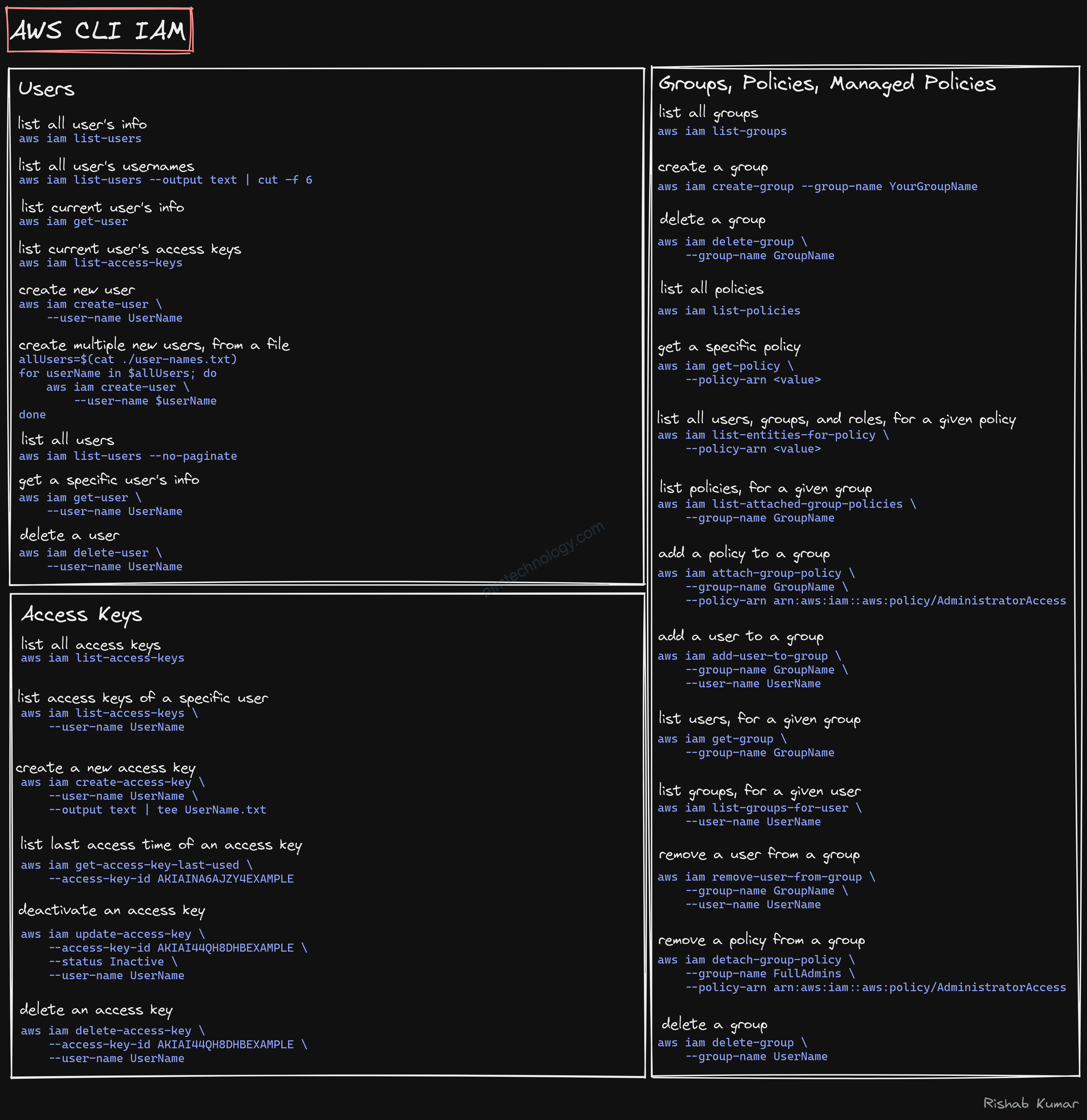
IAM
EC2
Prevent deletion of EC2:
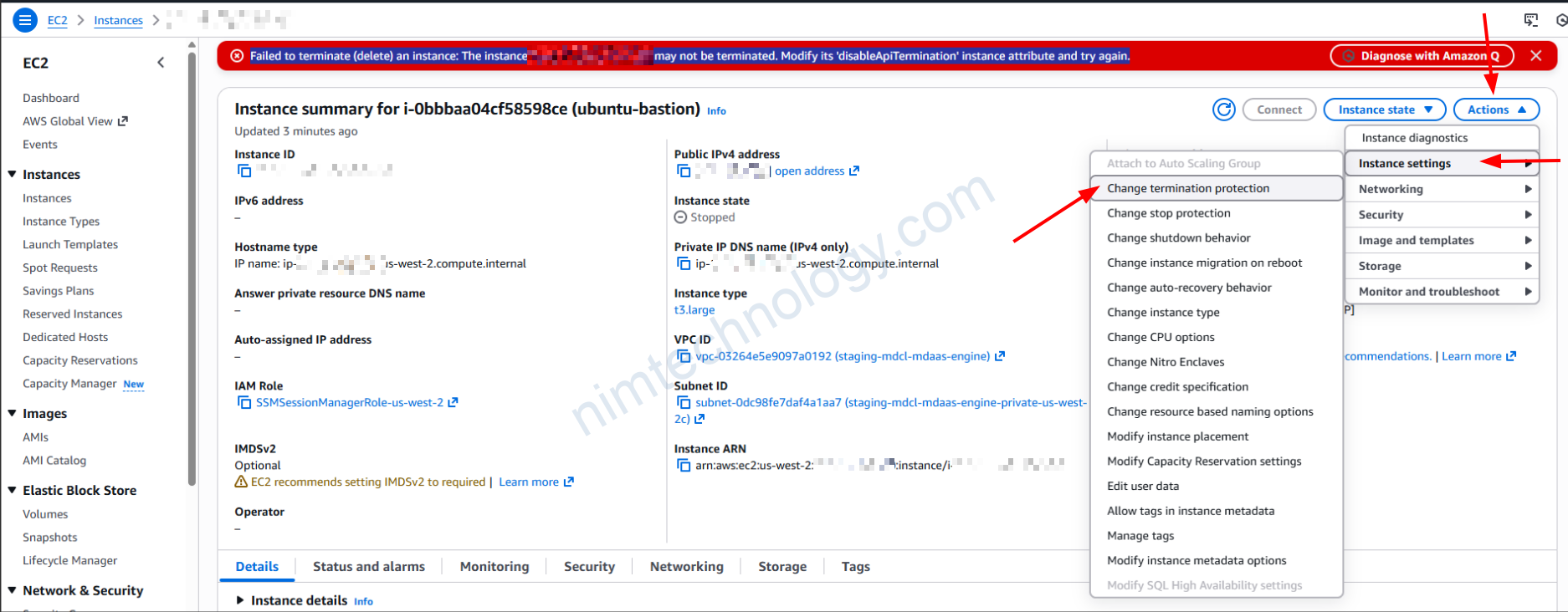
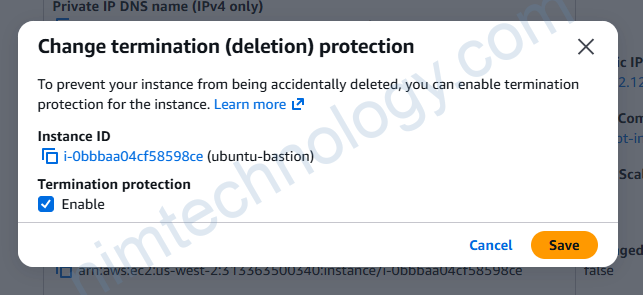
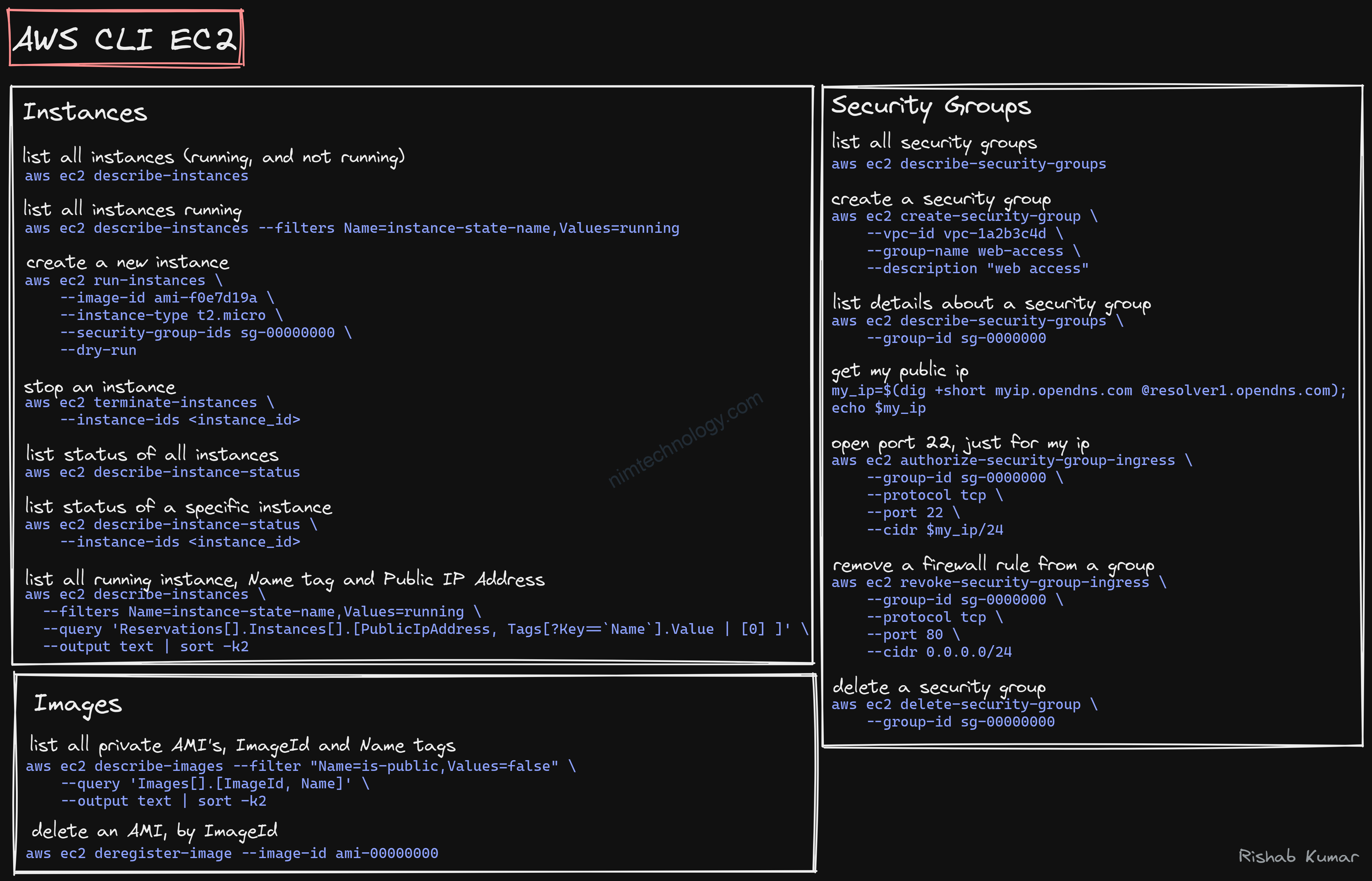
List volume gp2:
aws ec2 describe-volumes --region us-west-2 --filters Name=volume-type,Values=gp2 \
--query "Volumes[].{Region:'us-west-2',VolumeId:VolumeId,AZ:AvailabilityZone,Size:Size,State:State,InstanceId:Attachments[0].InstanceId,Created:CreateTime}" \
--output table
EC2 instance stopped for at least 90 days has EBS volume attached
#!/bin/bash

# This script lists EC2 instances that have been stopped for more than 90 days.
# It also lists the attached EBS volumes for those instances.

echo "Checking for instances stopped > 90 days..."
printf "%-20s %-25s %-s\n" "INSTANCE_ID" "STOPPED_DATE" "VOLUME_IDS"
echo "--------------------------------------------------------------------------------"

aws ec2 describe-instances \
  --filters "Name=instance-state-name,Values=stopped" \
  --output json | jq -r '
    now as $now |
    ($now - (90 * 86400)) as $cutoff |
    .Reservations[].Instances[] |

    # Filter for instances with a StateTransitionReason containing a date
    select(.StateTransitionReason != null and (.StateTransitionReason | test("\\(\\d{4}-\\d{2}-\\d{2} \\d{2}:\\d{2}:\\d{2} GMT\\)"))) |

    .StateTransitionReason as $reason |
    ($reason | capture("\\((?<d>\\d{4}-\\d{2}-\\d{2} \\d{2}:\\d{2}:\\d{2}) GMT\\)") | .d) as $date_str |

    # Parse date to epoch
    ($date_str | strptime("%Y-%m-%d %H:%M:%S") | mktime) as $stop_time |

    # Check if stopped before cutoff (older than 90 days)
    select($stop_time <= $cutoff) |

    [
      .InstanceId,
      $date_str,
      ([.BlockDeviceMappings[].Ebs.VolumeId] | join(","))
    ] | @tsv
  ' | while IFS=$'\t' read -r instance_id stop_date volume_ids; do
    printf "%-20s %-25s %-s\n" "$instance_id" "$stop_date" "$volume_ids"
  done
List AWS EBS volumes that are not attached to any EC2 instances
#!/bin/bash

# Script to list AWS EBS volumes that are not attached to any EC2 instance (Available state)
# Displays VolumeId as the first column.

echo "Checking for unattached (available) EBS volumes..."

# Print custom header
printf "%-25s %-10s %-15s %-20s %-25s\n" "VolumeId" "Size(GB)" "Status" "AvailabilityZone" "CreateTime"
echo "-----------------------------------------------------------------------------------------------"

# Use aws ec2 describe-volumes with filter for status=available
# We use --output text and a list projection [...] to strictly preserve column order
# Then we use 'column -t' (if available) or just let the shell formatting handle it,
# but simply printing strictly ordered text is the best way to control column order.
aws ec2 describe-volumes \
    --filters Name=status,Values=available \
    --query "Volumes[*].[VolumeId, Size, State, AvailabilityZone, CreateTime]" \
    --output text | \
    while read -r vol_id size state zone time; do
        printf "%-25s %-10s %-15s %-20s %-25s\n" "$vol_id" "$size" "$state" "$zone" "$time"
    done

echo "Done."
Elastic IP address without a resource associated
aws ec2 describe-addresses --query "Addresses[?AssociationId==null].{PublicIp:PublicIp, AllocationId:AllocationId, Domain:Domain}" --output table
ELBv1 does not have listeners
#!/bin/bash

echo "=== AWS ELBv1 (Classic Load Balancer) Report ==="

# 1. List ALL ELBv1 Load Balancers
echo -e "\n1. Listing ALL Classic Load Balancers:"
aws elb describe-load-balancers \
    --query "LoadBalancerDescriptions[*].{LoadBalancerName:LoadBalancerName, DNSName:DNSName, ListenerCount:length(ListenerDescriptions)}" \
    --output table

# 2. List ELBv1 Load Balancers with NO Listeners
echo -e "\n2. Listing Classic Load Balancers with NO listeners:"
aws elb describe-load-balancers \
    --query "LoadBalancerDescriptions[?length(ListenerDescriptions)==\`0\`].{LoadBalancerName:LoadBalancerName, DNSName:DNSName, CreatedTime:CreatedTime}" \
    --output table

echo -e "\nDone."
ELBv2 does not have listeners
#!/bin/bash

echo "Checking ELBv2 (ALB/NLB) for missing listeners..."
printf "%-50s %-20s %-15s\n" "LoadBalancerName" "Type" "Status"
echo "--------------------------------------------------------------------------------------"

# Get all ELBv2 ARNs, Names, and Types
# Format: Arn|Name|Type
aws elbv2 describe-load-balancers \
    --query "LoadBalancers[].[LoadBalancerArn, LoadBalancerName, Type]" \
    --output text | while read -r arn name lb_type; do

    # Check listener count for this specific Load Balancer
    listener_count=$(aws elbv2 describe-listeners --load-balancer-arn "$arn" --query "length(Listeners)" --output text 2>/dev/null)

    # If count is 0 or empty, print it
    if [[ "$listener_count" == "0" || -z "$listener_count" ]]; then
        printf "%-50s %-20s %-15s\n" "$name" "$lb_type" "NO LISTENERS"
    fi
done

echo "Done."
s3
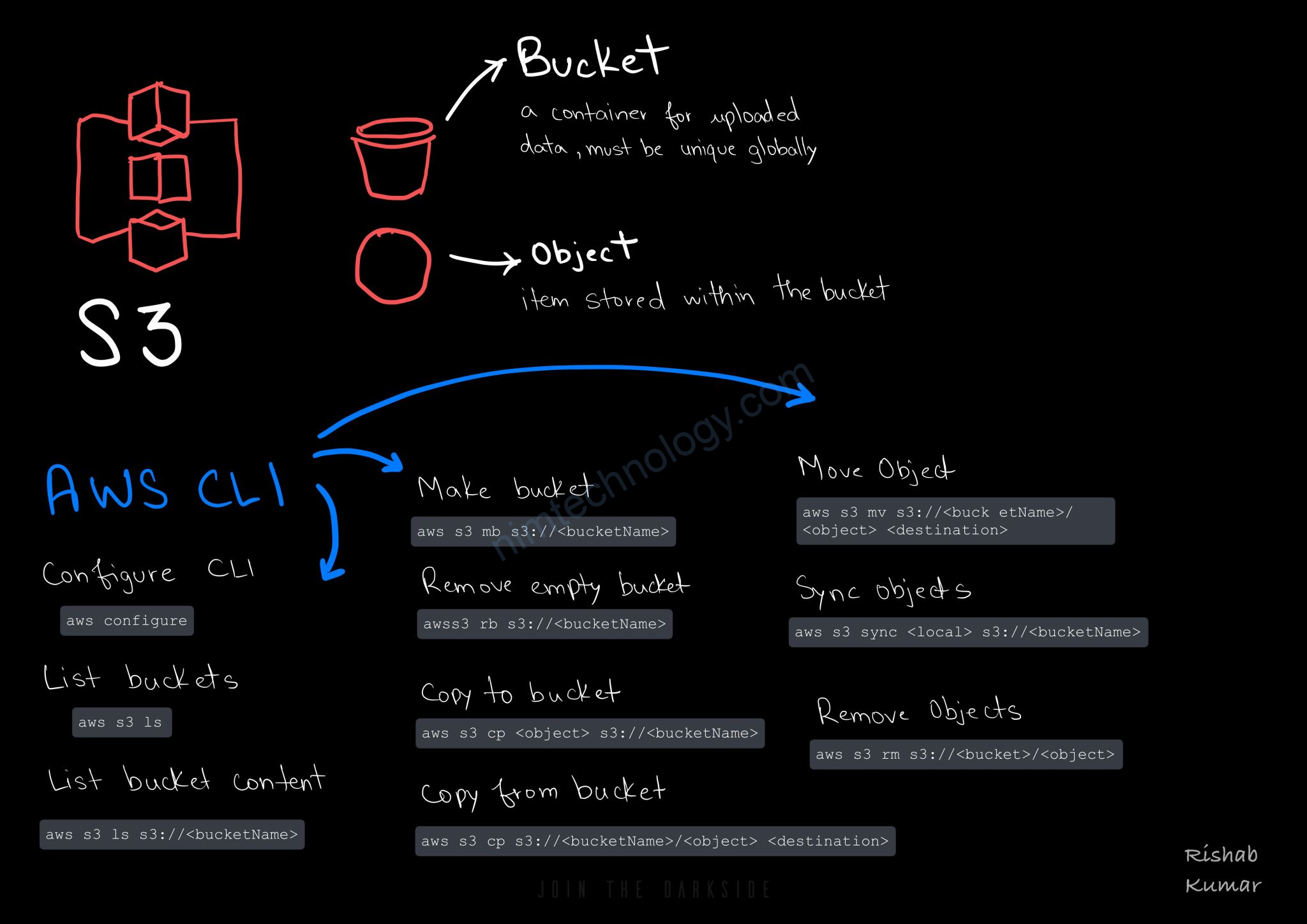
https://github.com/rishabkumar7/cloud-cheat-sheets
>>>>> https://stackoverflow.com/questions/27932345/downloading-folders-from-aws-s3-cp-or-sync
Using aws s3 cp from the AWS Command-Line Interface (CLI) will require the --recursive parameter to copy multiple files.
aws s3 cp --recursive s3://myBucket/dir localdir
The aws s3 sync command will, by default, copy a whole directory. It will only copy new/modified files.
aws s3 sync s3://mybucket/dir localdir
Just experiment to get the result you want.
Documentation:
check folder size on S3
aws s3 ls s3://<bucket_name>/<folder_name>/ --recursive --summarize --human-readable

example: aws s3 ls s3://nim-dataset-of-rainmaker/avtest/ --recursive --summarize --human-readable
Checksum S3 files by Golang
https://github.com/aws-samples/amazon-s3-checksum-tool
S3 express one zone
copy file from s3 standard to s3 express one zone
root@LE11-D7891:~# time aws s3 cp s3://artifactory/1GB.txt s3://demo-s3-express-one-zone--usw2-az1--x-s3/1GB-v3.txt
copy: s3://artifactory/1GB.txt to s3://demo-s3-express-one-zone--usw2-az1--x-s3/1GB-v3.txt

real    0m32.645s
user    0m0.905s
sys     0m0.094s
copy file from s3 express one zone to s3 standard
time aws s3 cp s3://demo-s3-express-one-zone--usw2-az1--x-s3/1GB.txt s3://artifactory-nim/1GB-v5.txt --storage-class ONEZONE_IA --copy
-props none
copy: s3://demo-s3-express-one-zone--usw2-az1--x-s3/1GB.txt to s3://artifactory-nim/1GB-v5.txt

real    0m14.737s
user    0m0.872s
sys     0m0.087s
Find S3 Bucket BucketKey is disabled
list-s3-bucketkey-disabled.sh
#!/usr/bin/env bash
set -euo pipefail

usage() {
  cat <<'EOF'
Usage: list-s3-bucketkey-disabled.sh [--kms-only]

Lists S3 buckets whose default encryption rules have the bucket key disabled.
Requires awscli and jq.

Options:
  --kms-only   Restrict results to rules using aws:kms algorithms.
EOF
}

kms_only=0

while [[ $# -gt 0 ]]; do
  case "$1" in
    -h|--help)
      usage
      exit 0
      ;;
    --kms-only)
      kms_only=1
      ;;
    *)
      echo "Unknown option: $1" >&2
      usage >&2
      exit 1
      ;;
  esac
  shift
done

get_bucket_region() {
  local bucket="$1"
  local location
  if ! location=$(aws s3api get-bucket-location \
      --bucket "$bucket" \
      --query 'LocationConstraint' \
      --output text 2>/dev/null); then
    echo "" # unknown/forbidden
    return
  fi
  case "$location" in
    None|"") echo "us-east-1" ;;
    EU) echo "eu-west-1" ;;
    *) echo "$location" ;;
  esac
}

buckets=$(aws s3api list-buckets \
  --query 'Buckets[].Name' \
  --output text 2>/dev/null || true)

if [[ -z "$buckets" ]]; then
  echo "No buckets returned or access denied." >&2
  exit 1
fi

printf "%-40s %-15s %-20s %-60s %s\n" "Bucket" "Region" "SSEAlgorithm" "KMSKeyId" "BucketKeyEnabled"
printf "%-40s %-15s %-20s %-60s %s\n" "------" "------" "------------" "--------" "----------------"

found=0

for bucket in $buckets; do
  region=$(get_bucket_region "$bucket")
  if [[ -z "$region" ]]; then
    echo "Warning: skipping bucket '$bucket' (unable to determine region)." >&2
    continue
  fi

  if ! encryption_json=$(aws s3api get-bucket-encryption \
      --bucket "$bucket" \
      --region "$region" \
      --output json 2>/dev/null); then
    # No encryption or insufficient permissions.
    continue
  fi

  mapfile -t rules < <(
    jq -r '
        .ServerSideEncryptionConfiguration.Rules[]
          | {
              alg: .ApplyServerSideEncryptionByDefault.SSEAlgorithm,
              kms: (.ApplyServerSideEncryptionByDefault.KMSMasterKeyID // "aws/s3"),
              bucketKey: (.BucketKeyEnabled // false)
            }
          | select((.bucketKey | not))
          | [ .alg, .kms, (if .bucketKey then "true" else "false" end) ]
          | @tsv
    ' <<<"$encryption_json"
  )

  if [[ ${#rules[@]} -eq 0 ]]; then
    continue
  fi

  for rule in "${rules[@]}"; do
    IFS=$'\t' read -r alg kms bucket_key <<<"$rule"
    if [[ $kms_only -eq 1 && $alg != aws:kms* ]]; then
      continue
    fi
    printf "%-40s %-15s %-20s %-60s %s\n" "$bucket" "$region" "$alg" "$kms" "$bucket_key"
    found=1
  done
done

if [[ $found -eq 0 ]]; then
  if [[ $kms_only -eq 1 ]]; then
    echo "No S3 buckets found with aws:kms encryption and bucket keys disabled." >&2
  else
    echo "No S3 buckets found with bucket keys disabled." >&2
  fi
fiHow to run:
Run ./list-s3-bucketkey-disabled.sh for the full view, or add --kms-only to focus on KMS-encrypted buckets.Find S3 bucket does not have a lifecycle rule to delete incomplete multipart uploads
root@LE11-D7891:~# cat find_incomplete_mpu_buckets.sh
#!/bin/bash

# Print header
printf "%-50s | %-20s\n" "Bucket Name" "Status"
printf "%s\n" "---------------------------------------------------|---------------------"

# Get list of buckets
buckets=$(aws s3api list-buckets --query "Buckets[].Name" --output text)

if [ $? -ne 0 ]; then
    echo "Error listing buckets. Please check your AWS credentials."
    exit 1
fi

for bucket in $buckets; do
    # Check lifecycle configuration
    # We suppress stderr to capture specific error codes if needed, or just parse the output
    lifecycle_output=$(aws s3api get-bucket-lifecycle-configuration --bucket "$bucket" --output json 2>&1)
    exit_code=$?

    if [ $exit_code -ne 0 ]; then
        if echo "$lifecycle_output" | grep -q "NoSuchLifecycleConfiguration"; then
             printf "%-50s | %-20s\n" "$bucket" "No Lifecycle Config"
        elif echo "$lifecycle_output" | grep -q "AccessDenied"; then
             printf "%-50s | %-20s\n" "$bucket" "Access Denied"
        else
             printf "%-50s | %-20s\n" "$bucket" "Error"
        fi
    else
        # Check if AbortIncompleteMultipartUpload exists in the rules
        if echo "$lifecycle_output" | grep -q "AbortIncompleteMultipartUpload"; then
            # Found the rule, so this bucket is fine. We skip printing it or print "OK" if verbose.
            # User asked to find those *without* the rule.
            continue
        else
            printf "%-50s | %-20s\n" "$bucket" "Missing MPU Rule"
        fi
    fi
doneSecrets Manager.
https://www.learnaws.org/2022/08/28/aws-cli-secrets-manager/#how-to-list-all-secrets
ECR
Retagging an image: https://docs.aws.amazon.com/AmazonECR/latest/userguide/image-retag.html
You can retag without pulling or pushing the image with Docker.
Mình có tìm được 1 script của 1 anh trai:
Để chạy được script trên thì:
chmod +x ecr_add_tag.shSource the Script: You can source the script into your shell so that you can use the ecr-add-tag function directly:
source ecr_add_tag.shHow to Use the Function
After sourcing the script, you can use the function ecr-add-tag in your terminal as follows:
ecr-add-tag ECR_REPO_NAME TAG_TO_FIND TAG_TO_ADD [AWS_PROFILE]ECR_REPO_NAME: The name of the ECR repository.TAG_TO_FIND: The existing tag of the image you want to re-tag.TAG_TO_ADD: The new tag you want to add to the image.[AWS_PROFILE]: (Optional) The AWS profile to use. If not provided, the default profile is used.
Example:
ecr-add-tag my-ecr-repo 1.0.0 1.0.1 my-aws-profileScript to be easier
#!/usr/bin/env bash

# Disable AWS CLI pager
export AWS_PAGER=""

# Check for the correct number of arguments
if (( $# < 3 )); then
  echo "Wrong number of arguments. Usage: $0 ECR_REPO_NAME TAG_TO_FIND TAG_TO_ADD [AWS_PROFILE]"
  exit 1
fi

# Parse the arguments
repo_name=$1
existing_tag=$2
new_tag=$3
profile=$4

# If a profile is provided, format it correctly
[[ ! -z "$profile" ]] && profile="--profile ${profile}"

# Fetch the existing image manifest
manifest=$(aws ecr batch-get-image ${profile} \
                    --repository-name $repo_name \
                    --image-ids imageTag=$existing_tag \
                    --query 'images[].imageManifest' \
                    --output text)

# Add the new tag to the image
aws ecr put-image ${profile} \
                  --repository-name $repo_name \
                  --image-tag $new_tag \
                  --image-manifest "${manifest}"
Sau đó bạn run:
bash ecr-add-tag.sh alpine/terragrunt 1.1.7-eks 1.1.7-eks.v6 nim-devAWS CLi Deployment
apiVersion: apps/v1
kind: Deployment
metadata:
  labels:
    workload.user.cattle.io/workloadselector: apps.deployment-nim-engines-dev-aws-cli
  name: aws-cli
  namespace: nim-engines-dev
spec:
  replicas: 1
  selector:
    matchLabels:
      workload.user.cattle.io/workloadselector: apps.deployment-nim-engines-dev-aws-cli
  strategy:
    rollingUpdate:
      maxSurge: 25%
      maxUnavailable: 25%
    type: RollingUpdate
  template:
    metadata:
      labels:
        workload.user.cattle.io/workloadselector: apps.deployment-nim-engines-dev-aws-cli
      namespace: nim-engines-dev
    spec:
      containers:
        - command:
            - /bin/sh
            - '-c'
            - while true; do sleep 3600; done
          env:
            - name: AWS_ACCESS_KEY_ID
              value: XXXXXXXXXXX
            - name: AWS_SECRET_ACCESS_KEY
              value: XXXXXXXXXXXXXXXL0eXPPXXXXHUU1bW
            - name: AWS_DEFAULT_REGION
              value: us-west-2
          image: amazon/aws-cli:latest
          imagePullPolicy: Always
          name: aws-cli
          resources: {}
          securityContext:
            allowPrivilegeEscalation: false
            privileged: false
            readOnlyRootFilesystem: false
            runAsNonRoot: false
          terminationMessagePath: /dev/termination-log
          terminationMessagePolicy: File
          volumeMounts:
            - mountPath: /app/downloaded
              name: file-service
      dnsPolicy: ClusterFirst
      nodeSelector:
        kubernetes.io/os: linux
      restartPolicy: Always
      schedulerName: default-scheduler
      securityContext: {}
      terminationGracePeriodSeconds: 30
      volumes:
        - name: file-service
          persistentVolumeClaim:
            claimName: pvc-file-service-smb-1
ELB
Find ELBv2 instances without listeners.
#!/usr/bin/env bash
set -euo pipefail

usage() {
  cat <<'EOF'
Usage: list-empty-elbv2.sh [--all-regions] [region ...]

  --all-regions   Query every active AWS region (overrides other region args).
  region          Explicit region(s) to query (space separated).

If no regions are provided, the script uses AWS_REGION (space separated list allowed),
falling back to us-east-1.
EOF
}

regions=()

while [[ $# -gt 0 ]]; do
  case "$1" in
    -h|--help)
      usage
      exit 0
      ;;
    --all-regions)
      mapfile -t regions < <(
        aws ec2 describe-regions \
          --query 'Regions[].RegionName' \
          --output json |
        jq -r '.[]'
      )
      ;;
    -*)
      echo "Unknown option: $1" >&2
      usage >&2
      exit 1
      ;;
    *)
      regions+=("$1")
      ;;
  esac
  shift
done

if [[ ${#regions[@]} -eq 0 ]]; then
  if [[ -n "${AWS_REGION:-}" ]]; then
    # Allow AWS_REGION to contain a space- or comma-separated list.
    IFS=' ,'
    read -r -a regions <<< "${AWS_REGION}"
    unset IFS
  else
    regions=(us-east-1)
  fi
fi

# Deduplicate while preserving order.
declare -A seen=()
unique_regions=()
for region in "${regions[@]}"; do
  [[ -z "$region" ]] && continue
  if [[ -z "${seen[$region]:-}" ]]; then
    seen["$region"]=1
    unique_regions+=("$region")
  fi
done

if [[ ${#unique_regions[@]} -eq 0 ]]; then
  echo "No regions to query." >&2
  exit 1
fi

printf "%-20s %-40s %s\n" "Region" "LoadBalancerName" "LoadBalancerArn"
printf "%-20s %-40s %s\n" "------" "------------------" "----------------"

found=0

for region in "${unique_regions[@]}"; do
  mapfile -t load_balancers < <(
    aws elbv2 describe-load-balancers \
      --region "$region" \
      --query 'LoadBalancers[].{Name:LoadBalancerName,Arn:LoadBalancerArn}' \
      --output json |
    jq -r '.[] | [.Name, .Arn] | @tsv'
  )

  if [[ ${#load_balancers[@]} -eq 0 ]]; then
    continue
  fi

  for lb in "${load_balancers[@]}"; do
    IFS=$'\t' read -r name arn <<< "$lb"
    listener_count=$(aws elbv2 describe-listeners \
      --region "$region" \
      --load-balancer-arn "$arn" \
      --query 'Listeners | length(@)' \
      --output text 2>/dev/null || echo 0)
    if [[ "$listener_count" == "0" || "$listener_count" == "None" ]]; then
      printf "%-20s %-40s %s\n" "$region" "$name" "$arn"
      found=1
    fi
  done
done

if [[ $found -eq 0 ]]; then
  echo "No listenerless ELBv2 load balancers found." >&2
fiRun
root@LE11-D7891:~# bash ./list-empty-elbv2.sh --all-regions
Region               LoadBalancerName                         LoadBalancerArn
------               ------------------                       ----------------
No listenerless ELBv2 load balancers found.